Reach us at: (417) 459-4579
How Much Lift Do You Need for 33, 35 and 37 Inch Tires? A Truck-by-Truck Answer
By Dustan Stroud, owner of Missouri Off-Road in Branson, MO
On most half-ton trucks, a 2 to 2.5 inch leveling kit fits a 33-inch tire, a 3 to 4 inch lift fits 35s, and 37s take about 6 inches of lift plus some trimming. A Super Duty F-250 or F-350 is easier: a lot of them come from the factory with about a 34-inch tire, so a leveling kit gets 35s on easily, and 37s don’t take a big lift. Tacomas and 4Runners need roughly an inch more lift for each tire size, and a Jeep Wrangler JL Rubicon fits 35s with almost no lift at all. 40s are a different project — plan on gears or portal kits, and expect trimming.
This is our main tire-size guide. The short sections below are the starting point. We’ll add deeper truck posts, plus guides on wheel width and offset and on running 40s, and link them here as they go up. Lift height is only half the answer: tire width and wheel width decide whether a tire rubs just as much as how tall the truck sits.
Quick answer
- 33-inch tires: a 2–2.5″ leveling kit on an F-150, Silverado/Sierra 1500 or Ram 1500. A Tacoma or 4Runner usually needs a 3″ lift and some trimming.
- 35-inch tires: a 3–4″ lift on most half-tons. Most people run a 35×12.50. A 35×11.50 means less trimming, and a 2021+ F-150 or 2019+ GM 1500 can often run that narrower 35 on a 2–3″ level. A JL Rubicon can run 35s at stock height with bump-stop extensions.
- 37-inch tires: about 6″ of lift on a half-ton, or 2.5–3.5″ on a JL Wrangler, and plan on trimming. Regearing is a drivability call — see Dustan’s take below.
- Super Duty (F-250 / F-350): a 2–2.5″ level for 35s. 37s are pretty easy with a modest level or lift, especially on a 2023+. On the 2017–2022s, wheel offset matters more than lift height.
- 40-inch tires: a different project. Plan on gears or portal kits, and expect trimming. See the short 40s section below.
- What decides rubbing: tire width and wheel width. On a 9-inch wheel, run the 11.50. On a 10-inch wheel, run the 12.50.
- Not sure it fits? Call or text us at 417-459-4579 and we’ll double-check your parts against your truck.
I’ve been doing this a little over 26 years, and “what size tire can I run?” is still the question I get the most at the counter. The honest answer is “it depends,” which nobody wants to hear, so this guide breaks it down truck by truck. It uses manufacturer specs, what owners report on the forums and in owner groups, and what we see on trucks that come through our shop in Branson.
Lift height vs tire size chart: what fits on each truck?
This is the starting point. “Trim” means anything from pulling a mud flap to cutting metal, and it’s noted where owners commonly report it. Every tire brand measures a little differently, so test-fit before you mount a full set. 40s aren’t in this chart on purpose — they’re a different build, covered in the short section further down.
| Truck (years) | Typical stock tire | 2–2.5″ leveling kit | 3–4″ lift | 6″ lift | Trim needed? |
|---|---|---|---|---|---|
| Ford F-150 (2015–2020) | ~32″ | 33″ | 34–35″ | 35″ (37″ with trimming) | 35s on a level usually need liner/air-dam trim |
| Ford F-150 (2021+) | ~32–33″ | 33″, often 35×11.50 | 35″ (Rough Country 3″ kit rated to 34″) | 35″ (37″ with trimming) | 35×12.50 often hits the crash bar and liner without the right offset |
| Silverado / Sierra 1500 (2019+) | ~33″ (275/60R20) | 34″ (275/65R20); 35×11.50 on 2.5–3″ | 35″ (shop example: 3.5″ with 35×12.50 on 18×9) | 35″ (37″ is a big build) | Often just a liner pull-back; mud flaps or the liner bracket when needed |
| Ram 1500 (2019+, non-air) | ~32–33″ | 34″ (295/60R20), 35×11.50 | 35″ | 35″ | 35×12.50 crowds the upper control arm on factory wheels |
| Toyota Tacoma (2016–2023) | ~30.5–31″ | 32″ | 33″ | 35″ (major build) | 33s commonly need a cab-mount chop |
| Toyota 4Runner (2010–2024) | ~31.6″ | 32″ | 33″ (285/70R17) | — | Liner push-back, bumper trim, sometimes a body-mount chop |
| Jeep Wrangler JL (2018+) | 32″ (Sport) / 33″ (Rubicon) | 33″ (Sport); 35″ on a Rubicon with bump stops | 35″ (Sport, 2.5″); 37″ (2.5–3.5″) | 37″+ | Bump-stop extensions; 37s want flat or high-clearance fenders |
| Ford F-250 / F-350 Super Duty (2017–2022, SRW) | ~33–34″ (LT275/70R18 or LT275/65R20); Tremor ~34.8″ | 35″ | 37″ (right wheels) | 37″ | 35s often just mud-flap or valence trim; 37s on stock wheels commonly rub the radius arms and sway bar |
| Ford F-250 / F-350 Super Duty (2023+, SRW) | same stock sizes; Tremor ~34.8″ | 35″, often 37×12.50 | 37″ | 37″ | 2023+ radius arms and sway bar have more clearance; liner or mud-flap trim on 37s is still common |
| Ram 2500 / Silverado 2500HD | ~33–34″ | 35″ | 37″ (check radius-arm and bumper clearance) | 37″+ | 37s need more than a level |
Want the parts for any of these? Browse our lift kits and leveling kits, or skip ahead to your truck. We’ll also add deeper guides for the Bronco and other trucks we see a lot in the shop.
Why do tire width and wheel offset matter as much as lift?
Lift raises the truck, but a lot of rubbing happens sideways, not up and down. A wider tire, or a more negative-offset wheel that pushes the tire out, is usually what starts the trimming.
Dustan’s take: Most of the time you’re going to be running a 35×12.50. If you’re concerned about fitment on your specific vehicle, some of the 35×11.50 options are going to be better and keep you from having to do as much trimming. If you’re only thinking about a 9-inch-wide wheel, the 11.50 is a good choice — a skinnier tire is going to give you fewer fitment issues, period. If you want to run a 10-inch-wide wheel, don’t put an 11.50 on it. At that width, you want the 12.50.
We’ll go deeper on width, offset and backspacing in an upcoming post. If only one side rubs, get it checked before you start cutting. Owners have traced that to a missed spacer, a bent bracket or an uneven alignment.
How much lift does a Ford F-150 need for 33s, 35s and 37s?
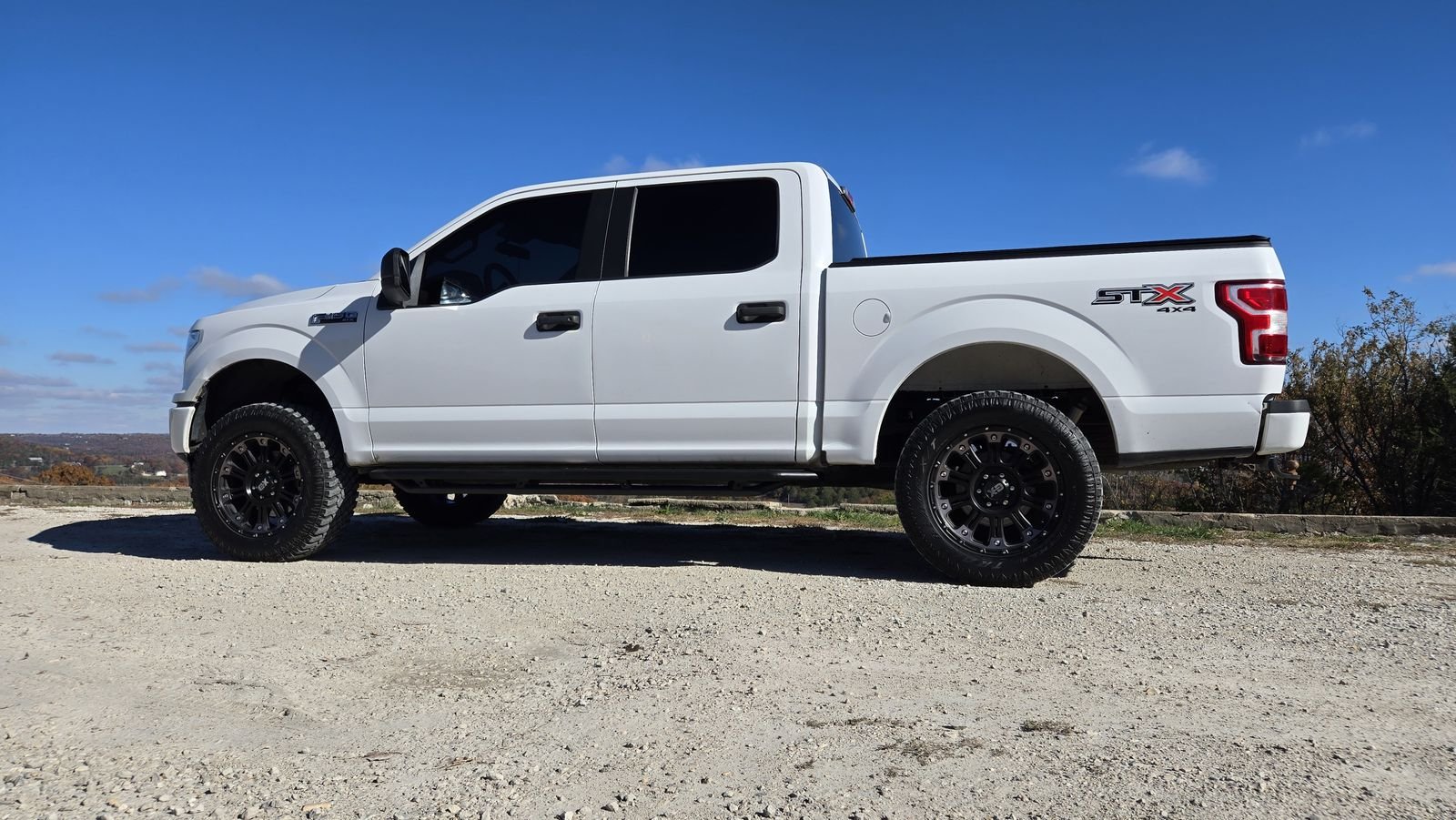
2015–2020 F-150 (13th gen): The Rough Country 2″ F-150 leveling kit is rated for a 33-inch tire. 34s and 35s on a level usually mean trimming the front fender liner and air dam. For clean 35s, most owners go to a 4-inch or bigger lift.
2021 and newer F-150 (14th gen): These trucks sit taller from the factory. Owners commonly run 35×11.50R20s on stock wheels with a 2-inch level and little or no trimming. A 35×12.50 gets tight on negative-offset wheels — the crash bar, the liner and sometimes the painted bumper corner. A wheel around +18 offset or more, or more lift, is the usual fix.
- The Rough Country 3″ forged upper control arm kit for 2021+ 4WD is rated for up to 34-inch tires, with no cutting or drilling.
- The 4″ no-cut kit for 2021+ 4WD is the step up if you want 35s with more room.
- The Rough Country 6″ lift for 2021+ 4WD was developed on a 35×12.50R20 and a 20×9 wheel with 4.5″ backspacing. Owners do run 37s on 6-inch F-150s, but that’s past the test setup, so expect trimming.
- F-150 Tremor (2021+): The 2.5″ Tremor kit is rated to run a 35×12.50 on the factory wheels with no trimming.
If you only want a level, see our F-150 leveling kit guide.
How much lift does a Silverado or Sierra 1500 need for 35s?
2019 and newer Silverado 1500 and Sierra 1500: These trucks come with about a 33-inch tire (275/60R20) on most trims. With a 2-inch level, owners commonly run 275/65R20 (about 34″) on stock wheels with no rub.
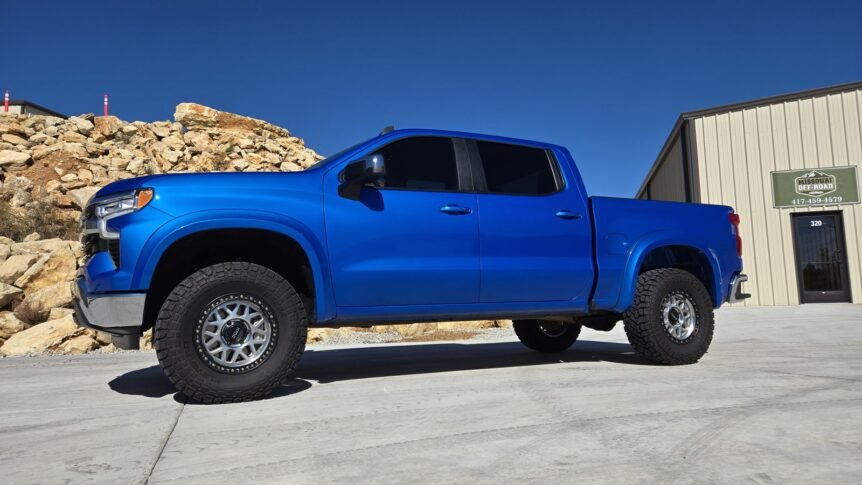
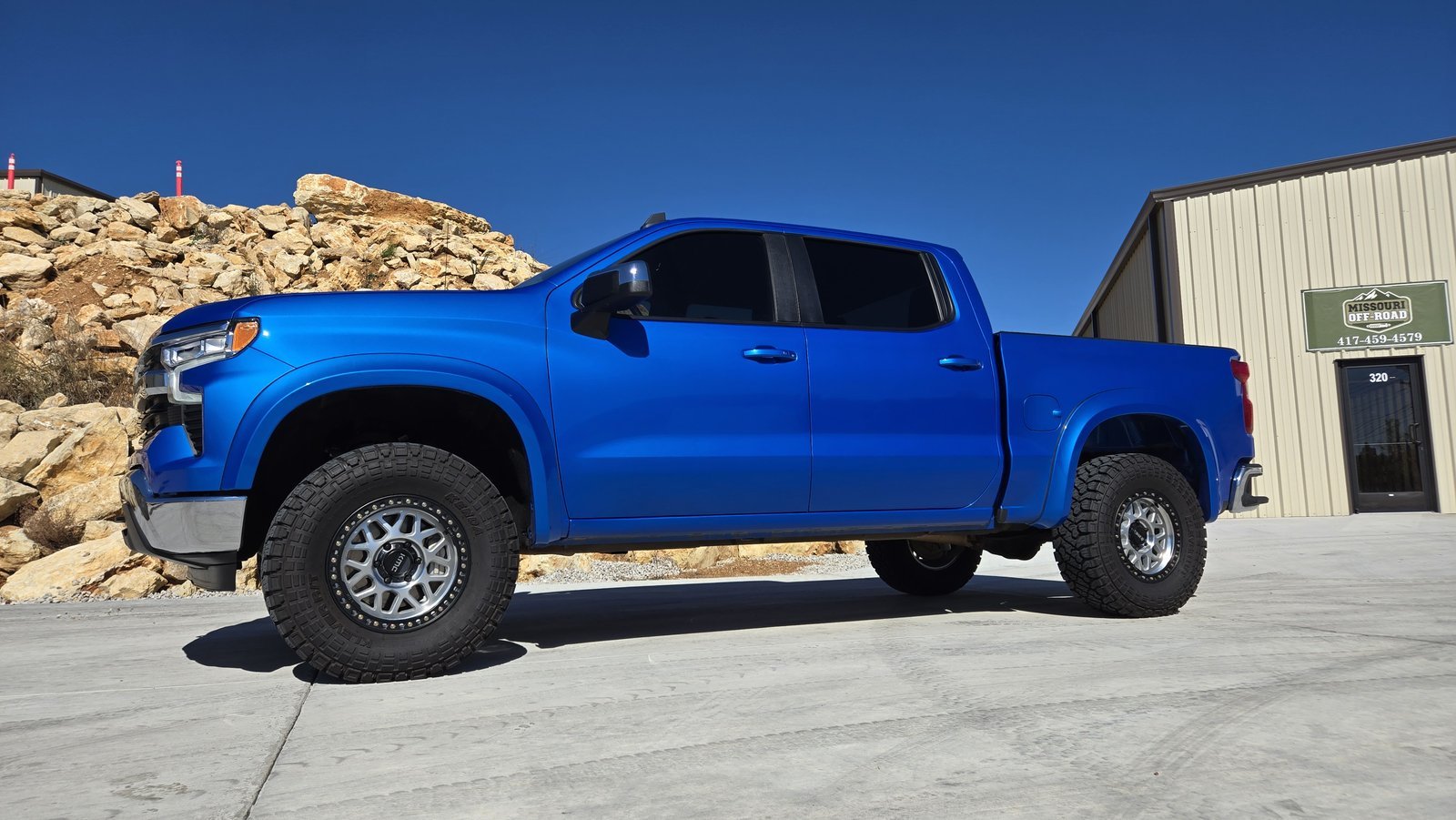
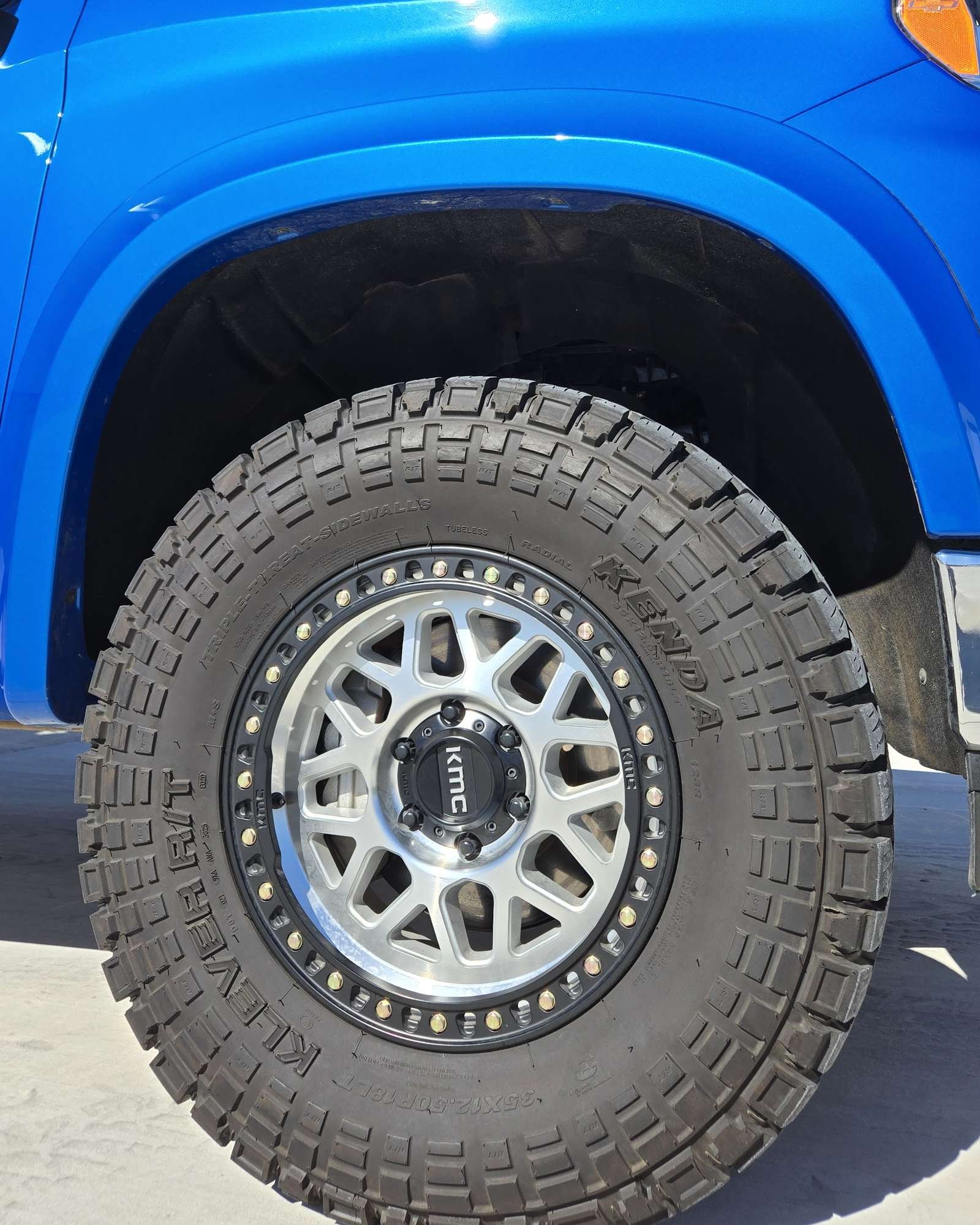
The blue 2025 Silverado in the photos is a good example of a 35-inch setup. It has the Rough Country 3.5-inch kit, 18×9 wheels and 35×12.50 tires. Dustan’s take: it only needed a minimal adjustment to the inner fender liner, just pulling some zip ties for the extra clearance.
A 2.5–3 inch level also gets 35s on, especially with a 35×11.50. When more trimming is needed, it’s usually the front mud flaps, the small metal bracket behind the fender liner, or a liner pull-back.
- The Rough Country 3.5″ lift for 2019–2024 Silverado 1500 (Sierra version) is rated for up to 295/55R20 tires.
- The 3.5″ kit for 2025–2026 Silverado 1500 is rated to 33″ and requires cutting and drilling.
- Trail Boss and AT4 already have about 2 inches of factory lift. Trail Boss owners can level the rest of the way with the 1.5″ Trail Boss leveling kit.
Will 35s fit a Ram 1500 with a leveling kit?
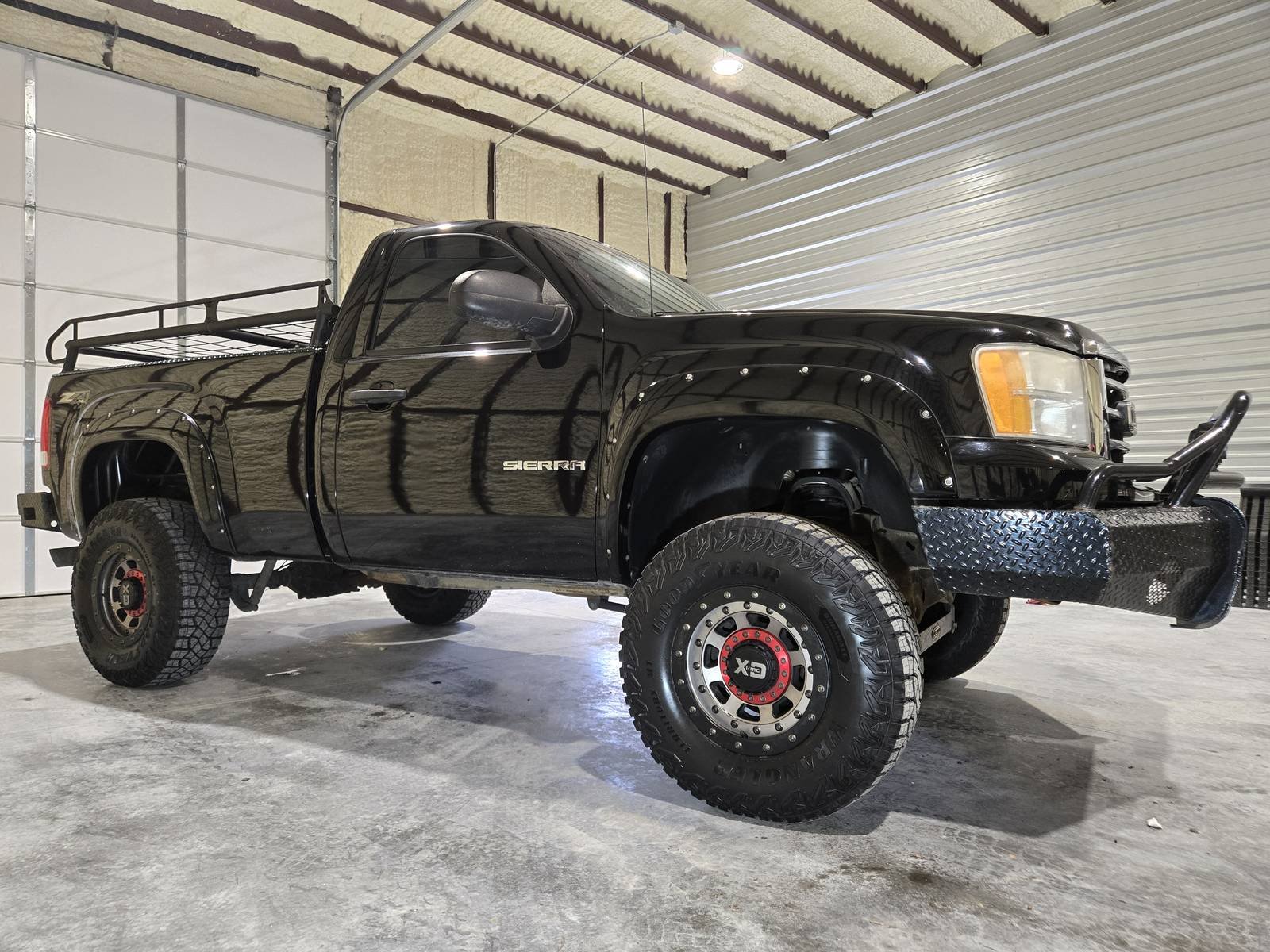
2019 and newer Ram 1500 (non-air ride): The Rough Country 2″ Ram 1500 leveling kit is rated for up to a 295/60R20 (about 34″) and a maximum tire width of 11.5″. Owners back that up: 35×11.50s and 285/65R20s fit on factory 20×9 wheels with a 2″ level. A 35×12.50 on factory offset hits the upper control arm, so plan on a spacer or different wheels, plus mud-flap and liner work.
For 35×12.50s, most Ram owners go to 3–3.5 inches. The Rough Country 3.5″ Ram 1500 lift bolts on with no cutting and fits Rebels. Keep tire width at 11.5″ on factory wheels. Trucks with factory 4-corner air ride need an air-ride-specific kit like the 2″ air ride leveling kit.
What size tires fit a Tacoma or 4Runner with a lift?
2016–2023 Toyota Tacoma (3rd gen): The Rough Country 2″ Tacoma leveling kit is rated for 32-inch tires. Owners who push a 285/70R17 (a true 33) on a level almost always pull the mud flaps and trim the liner, and many end up doing a cab-mount chop. The 3″ Tacoma lift and the 3.5″ kit with upper control arms are both rated for 33s and need minor cutting. 35s on a 3rd-gen Tacoma are a real project, not a weekend bolt-on.
2024 and newer Tacoma (4th gen): Owners report a 285/70R17 fits at stock height on factory-style offset wheels. The older Tacoma kits don’t fit these trucks. The Rough Country 3.5″ lift for 2024–2026 4WD is on the site; call or text the shop at 417-459-4579 if you want us to check fitment before you buy.
2010–2024 Toyota 4Runner (5th gen): A 275/70R17 (about 32″) is the easy step up. The Rough Country 3″ 4Runner lift is rated for 33s, and the 3″ kit with upper control arms adds caster adjustment. Owners on 285/70R17s with 3 inches of lift usually push the fender liners back and trim the bumper. Some also need a body-mount chop.
How much lift does a Jeep Wrangler need for 35s or 37s?
Jeep Wrangler JL (2018+): A Rubicon comes on 33s and has higher-clearance fenders. Owners run 35s on a stock-height Rubicon with 4.5″ backspacing wheels and bump-stop extensions so the tire can’t hit the fender when the suspension stuffs. A Sport or Sahara usually needs about 2.5 inches of lift plus bump stops for 35s. The Rough Country 2.5″ coil kit for 2018–2023 Unlimited is rated for 35s, and there’s a 2024–2026 version. 37s on a JL usually mean 2.5–3.5 inches of lift and bump stops. The 3.5″ Unlimited kit with adjustable lower control arms for 2018–2023 is the step up, with a 2024–2026 version as well. 2-door JL kits are on the site too. Plan on a reinforced tailgate hinge, because a 37-inch spare is a lot of weight hanging off a factory hinge.
Jeep Gladiator JT (2020+): Same idea as the JL. The 2.5″ JT spacer kit for 2020–2023 is rated for 35s, with a 2024–2026 version. If you want more room, the 3.5″ JT spring kit for 2020–2023 is rated for up to 37s, and there’s a 2024–2026 version.
Jeep Wrangler JK (2007–2018): Rough Country’s 0.75″ leveling kit for JK and JL is rated for up to 32-inch tires. For 35s on a JK, plan on a 2.5–3.5″ lift. The 2.5″ JK coil kit and the 3.5″ JK kit are both on the site, including Unlimited versions. If you’re not sure which year or two-door vs. Unlimited package you have, call or text the shop at 417-459-4579 and we’ll point you at the right one.
How much lift does a Ford Super Duty (F-250 or F-350) need for 35s and 37s?
A Super Duty is a different animal from an F-150. A lot of these trucks, especially on 20s, come from the factory with about a 34-inch tire (LT275/65R20). The common 18-inch package is about 33 inches (LT275/70R18). The Tremor, starting in 2020, comes with an LT285/75R18 — about 34.8 inches, which Ford calls a 35. So a leveling kit gets 35s on easily, and 37s don’t take a big lift. This is for single-rear-wheel trucks; duallies are a different fitment.
2017–2022: A 2–2.5″ level is the usual way to run 35×12.50s. Other manufacturers rate a 2.5″ Super Duty level for 35s. Rough Country is more conservative: the 2″ Super Duty leveling kit with a track bar bracket is rated for up to 33-inch tires. That’s the official number. Owners still commonly run 35s on a 2–2.5″ level, sometimes with a little mud-flap or valence trim at full lock. That kit doesn’t fully level 2017 models, and it doesn’t fit Tremor packages.
The catch is the wheel. Factory wheels sit way inboard, around +40 mm offset, and a 35×12.50 can brush the radius arms at full lock. A 9-inch wheel around +18 to +20 mm (about 5–5.5″ backspacing) is the clean 35-inch setup owners report. 37s will go on with a 2.5–4″ level or lift, but 37×12.50s on stock wheels commonly rub the radius arms and sway bar, and more lift by itself doesn’t fix that.
2023 and newer: Ford redesigned the radius arms and sway bar. A 37×12.50 can often sit on the factory +40 wheels without hitting the arms. You may still trim the liner or mud flaps. A 2–2.5″ level is still the usual way to make 37s look and fit right.
For a Tremor, the 3″ Tremor kit for 2019–2022 and the 2023–2026 Tremor kit are both on the site. If you want more than a level on a regular Super Duty, we have lift kits too, including the 3″ kit for 2017–2022 F-250 and the 3″ kit for 2023–2026 F-250 and F-350. If you’re not sure which package you have, call or text the shop at 417-459-4579 and we’ll point you at the right one. Get an alignment and have the caster set — Super Duties can get a death wobble if the track bar, drag link, ball joints or caster are off. The 2″ kit includes a track bar bracket to help keep the axle centered.
What about 3/4-ton trucks like the Ram 2500 and Silverado 2500HD?
2014 and newer Ram 2500: A 2.5″ front level like the Rough Country 2.5″ Ram 2500 leveling kit is the common setup for 35×12.50s, usually on 9-inch wheels around +18 offset. 37s need more than a level, because the tire starts reaching the radius arms and front bumper. For a real lift, we have the 5″ kit for 2019–2024 and the 5″ kit for 2025–2026. For a 2014–2018 or a package you’re not sure about, call or text the shop at 417-459-4579 and we’ll match a kit to your truck.
2020 and newer Silverado 2500HD and Sierra 2500HD: A 2-inch torsion-key level fits 35×12.50R20s on 20×9 wheels at 0 to +18 offset, with some tread patterns needing minor liner trim. Want 37s on a GM HD? That’s a real lift, not just a level — start with the 3″ UCA kit for 2020–2026 2500HD and 3500HD or the 5″ torsion-drop kit. If you’re not sure which height you need, call or text the shop at 417-459-4579.
For more on 3/4-ton setups, see how to choose the right lift kit for half-ton and 3/4-ton trucks.
What does it take to run 40s?
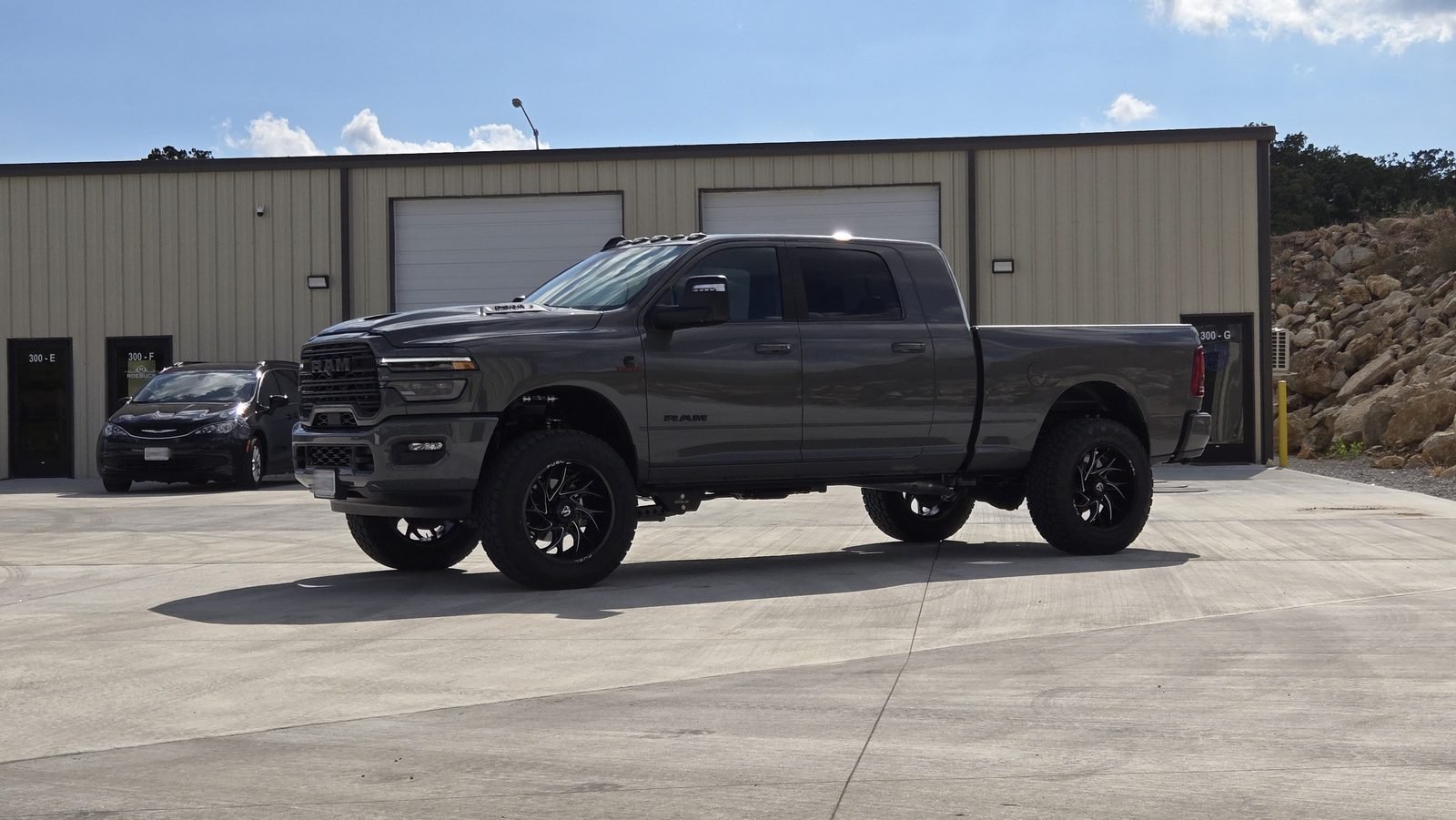
40s are a different level from 35s and 37s. Dustan’s take: if you want to run 40s on anything, plan on gears or portals that have gear reduction built in. A tall lift and a lot of cutting can sometimes make physical room, but 40s are heavy, and without gears or portals the truck usually feels lazy.
Portal kits raise the axle at the hub and add gear reduction there, so you get clearance and a lower effective gear without steepening the CVs the way a big suspension lift does. That’s why mid-size trucks and SUVs that used to top out around 33s or 35s are showing up on 40s. Even then, it’s a big build, and you often still have to trim.
A few examples from public sources, not a promise of a no-cut fit:
- 2024+ Tacoma, 2025+ 4Runner and 2024+ Lexus GX 550: Bolt-on portal kits exist for all three. One maker rates its kit for 35–37s without regearing the axles; shops have shown 40s on a 4th-gen Tacoma and a GX 550 with those same portals. Builders still talk about trimming, and at 40s, more clearance work like tubbing.
- Ranger Raptor and 6th-gen Bronco: A bolt-on portal kit is rated for 37s on the Ranger Raptor and 38s on the Bronco, with about 3.88″ of lift and a 22% reduction at the hub. Some installers say an extra front lift may still be needed for 37s or 40s, and even 37s have needed fender trim. That kit does not fit a base Ranger, a Bronco Raptor or an F-150 Raptor.
- F-150 Raptor and most half-tons: We didn’t find a production bolt-on portal kit for the F-150 Raptor. 40s on a Raptor, a regular F-150 or a Super Duty are a custom, heavy-build situation.
We don’t list portal kits on the site, so call us at 417-459-4579 if that’s the direction you’re headed.
Do you need to regear for 35 or 37 inch tires?
Bigger tires work like taller gears. The truck feels slower off the line, the transmission hunts more on hills, and the speedometer reads low until it’s recalibrated.
Dustan’s take: Regearing is very vehicle-specific. It depends on the driver, how and where they drive, and how much they tow. Today’s modern half-tons handle a 35-inch tire with no real problem. They’re all making 400-plus horsepower, and the 10-speed transmissions in the Chevys and Fords help a lot down low. If the truck is street-driven and you don’t tow a lot, half-tons still do pretty well on 37s, and gearing becomes a drivability call — though at 37s it should stay in the back of your mind as a possibility. If you tow a lot or do a lot of slow crawling and trail riding, gears are a must at 37s. If you want to run 40s on anything, plan on gears or portals that have gear reduction built in. And if you want your factory RPMs and factory feel, even a 35-inch tire could call for a gear swap.
There’s no cut-and-dry chart of “run this ratio at this tire size.” Once you’re into gears, you’re doing something custom and vehicle-specific, so you want to know exactly what you expect before you make that change. This is a starting point, case by case — not a hard rule.
| Tire size | Dustan’s take (case by case) |
|---|---|
| 35s | Modern half-tons usually handle them, especially with 400-plus horsepower and a 10-speed. A gear swap is still in play if you want factory RPM and feel. |
| 37s | Street-driven with little towing: a drivability call, but keep gears in the back of your mind. Tow a lot or do slow crawling and trail riding: gears are a must. |
| 40s | Plan on gears, or portals with gear reduction built in. See the 40s section above. |
On a Jeep JL, 4.88 is a common owner choice for 37s on the street, or 5.13 if they wheel. That’s a starting point, not a prescription. A Super Duty diesel has a lot of torque; many owners run 35s and even 37s without a swap if they don’t tow much. If you tow a lot, especially in the hills around here, 37s are where gears should stay in mind, and 3.31s with 37s is the combo owners like least. If your truck already feels lazy pulling a boat up from Table Rock, gears will fix it — a tuner or speedometer recalibration alone won’t.
What are the honest tradeoffs of a lift and bigger tires?
- Ride quality: Spacer-style leveling kits keep the factory ride. A full kit with new shocks changes it, sometimes for the better. Bigger tires add unsprung weight, so expect a little more thump over bumps.
- MPG: A 35-inch all-terrain can weigh around 70 pounds, and bigger, heavier tires cost you fuel economy. How much depends on the truck, the tire and your right foot.
- CV angles and wear: On independent front ends (every half-ton here except the Wrangler), more lift means steeper CV angles. Good kits use drop brackets or new knuckles to correct it, but ball joints and steering parts still wear faster on bigger tires.
- Alignment: Get one after every lift or level. It’s also your chance to set caster to help tire clearance.
- Warranty: A lift doesn’t void your whole factory warranty by itself. A dealer can deny a claim on a part they can show the lift caused, like a CV axle. Rough Country backs its suspension kits with a limited lifetime replacement warranty against manufacturer defects.
If you’re still deciding between a level and a full lift, read our leveling kit vs lift kit guide. For our honest take on the brand we sell the most of, see are Rough Country suspension kits any good?. Common rubbing fixes will get their own post soon.
Frequently asked questions
Can I fit 35s with just a leveling kit?
On a 2021+ F-150, a 2019+ Silverado or Sierra 1500, or a 2019+ Ram 1500, often yes, if you run a 35×11.50, keep a factory-style offset and accept light trimming like removing the mud flaps. A 35×12.50 on a level usually needs the right wheels and more trimming. On a Super Duty, 35s on a 2–2.5″ level are usually an easy fit. On a Tacoma or 4Runner, 35s on a level isn’t realistic.
What size tire fits a 2-inch leveling kit?
Most half-ton trucks fit a 33-inch tire. Rough Country rates its 2″ Ram 1500 kit for up to a 295/60R20 (about 34″), its 2″ F-150 kit for up to 33″, and a 2″ level on a 3rd-gen Tacoma for 32″. Its 2″ Super Duty kit is also rated for 33″, though owners commonly run 35s on a 2–2.5″ Super Duty level.
How much lift do I need for 37-inch tires?
On a half-ton F-150, Silverado or Ram 1500, plan on about 6 inches of lift and some trimming. On a Jeep Wrangler JL, owners run 37s on 2.5–3.5 inches of lift with bump stops. On a Super Duty, 37s often fit with a 2.5–4″ level or lift; wheel offset matters more than lift height on the 2017–2022 trucks. On a Ram 2500 or GM 2500HD, 37s need a real lift, not just a level.
What does it take to run 40-inch tires?
Plan on gears or portal kits with gear reduction built in. Mid-size trucks and SUVs like a Tacoma, 4Runner, Lexus GX 550 or Ranger Raptor are showing up on 40s with portals and trimming, but those are big builds, not a level and a set of tires. We don’t list portal kits on the site, so call us at 417-459-4579.
Do bigger tires hurt gas mileage?
Yes. Bigger, heavier tires and the added height both cost fuel economy, and the speedometer will read low until it’s recalibrated. Regearing gets back some of the lost drivability, but it won’t erase the extra weight and wind drag.
Do I need to regear for 35s?
Usually not on a modern half-ton. Dustan’s take: with 400-plus horsepower and a 10-speed, most half-tons handle 35s fine if you don’t tow a lot. If you want factory RPM and feel, even 35s could call for a gear swap, and it’s case by case. At 37s, gears are a must if you tow or crawl; otherwise it’s a drivability call. There’s no single ratio chart. At 40s, plan on gears or portals.
Will a lift kit void my warranty?
Not your whole warranty. A dealer can deny a claim on a specific part they can show the lift caused, so keep your receipts and have the kit installed correctly. Rough Country suspension kits carry a limited lifetime replacement warranty against manufacturer defects.
Why do my tires rub at full lock after a lift?
Full-lock rub is usually the tire hitting the mud flap, the fender liner, the liner’s metal bracket, the bumper corner or the body mount, and it comes from tire width and wheel offset more than lift height. Common fixes are removing the mud flaps, pulling back or trimming the liner, and adjusting caster at the alignment. If only one side rubs, check for a bent bracket or an uneven alignment first. On a 2017–2022 Super Duty, that rub is often the radius arms or the sway bar, especially on factory +40 mm wheels.
Can I run 37s on a Super Duty with just a leveling kit?
On a 2023 or newer F-250 or F-350, often yes, with a 2–2.5″ level and a 37×12.50. You may still trim the liner or mud flaps. On a 2017–2022, 37s can work on a 2.5–4″ level or lift, but stock wheels usually rub the radius arms and sway bar at full lock. A 9-inch wheel around +18 to +20 mm offset is the cleaner fit owners report. 35s on a Super Duty level are the easy yes.
Not sure what fits your truck?
Every truck is a little different, and tire brands don’t all measure the same. Not sure it fits? Call or text us at 417-459-4579 and we’ll double-check your parts against your truck. If you’re near Branson, we’ll install your lift or level at the shop at 320 Stonetree Dr, or you can order online and pick it up.
Financing is available: Affirm when you buy online, and Affirm or Afterpay in the store, including installs.
Shop lift kits · leveling kits · all suspension